
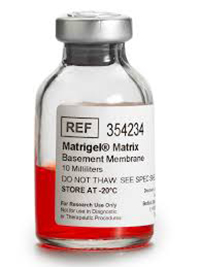
Description
Nearly 30 years ago, researchers were looking for a way to grow mouse sarcoma cells. The solution? The development of Corning Matrigel matrix. Matrigel is a solubilized basement membrane preparation extracted from the Engelbreth-Holm-Swarm (EHS) mouse sarcoma, a tumor rich in such ECM proteins as laminin (a major component), collagen IV, heparan sulfate proteoglycans, entactin/nidogen, and a number of growth factors.
Today, Matrigel, a natural ECM-based hydrogel is among the most widely used models for 2D and 3D cell culture in vitro. Corning matrigel enables you to:
- Improve the attachment and differentiation of normal and transformed anchorage-dependent epithelioid cells and other cell types.
- Better mimic in vivo environments for 2D and 3D cell culture applications.
Applications for Matrigel Matrix
Corning Matrigel matrix is effective for the attachment and differentiation of normal and transformed anchorage-dependent epithelioid and other cell types. These include neurons, Sertoli cells, chick lens, vascular endothelial cells, and hepatocytes.
Applications include:
- Influencing gene expression in adult rat hepatocytes
- 3D culture in mouse and human mammary epithelial cells
- In vivo peripheral nerve regeneration
- Metabolism and toxicology studies
- The development of several types of tumor cell invasion assays
- The in vitro and in vivo study of angiogenesis
- In vivo propagation of human tumors in immunosuppressed mice
- The maintenance of human embryonic stem cells and induced pluripotent stem (hiPS) cells
- Neuronal differentiation of hiPS cells
Matrigel Matrix Quality Control Specifications
- Mouse colonies routinely screened for pathogens via mouse antibody production (MAP) testing
- LDEV-free EHS tumor
- Extensive PCR testing performed on a number of pathogens, including LDEV, ensuring strict control of raw materials used during manufacturing
- Tested and found negative for the presence of bacteria, fungi, and mycoplasma
- Protein concentrations determined by Lowry method
- Endotoxin units measured by Limulus Amoebocyte Lysate assay
- Gel stability tested for a period of 14 days at 37°C
- Biological activity determined for each lot using a neurite outgrowth assay; chick dorsal root ganglia, plated on a 1.0 mm layer of Corning Matrigel matrix, required to generate positive neurite outgrowth response after 48 hours without addition of nerve growth factor

Reviews
There are no reviews yet.